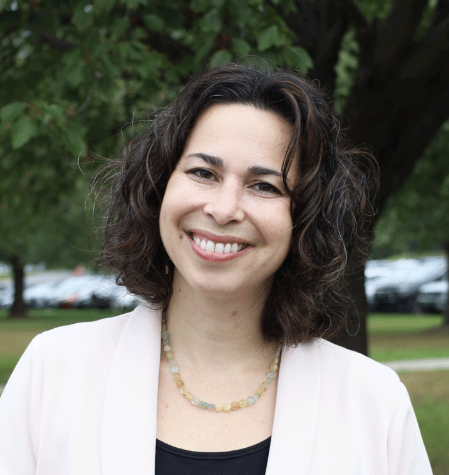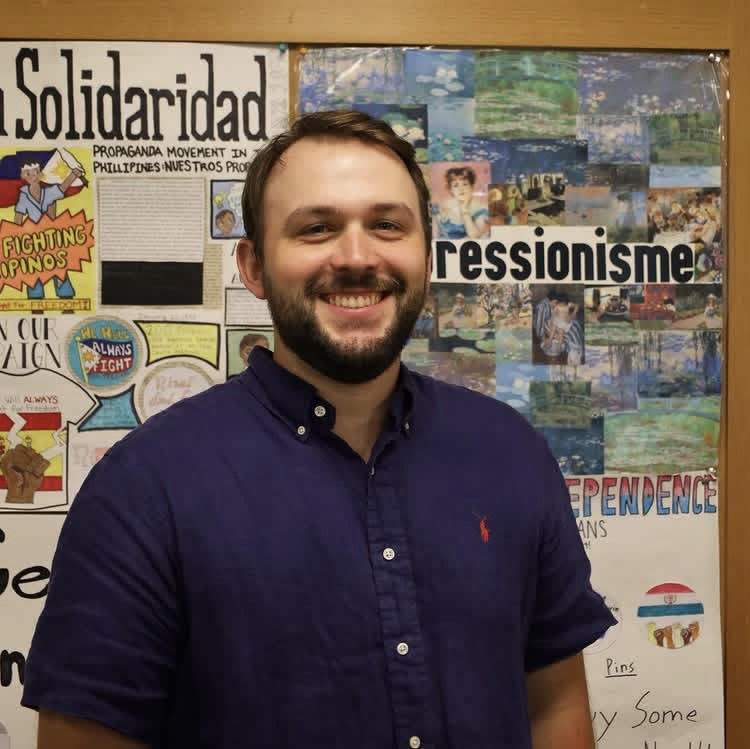
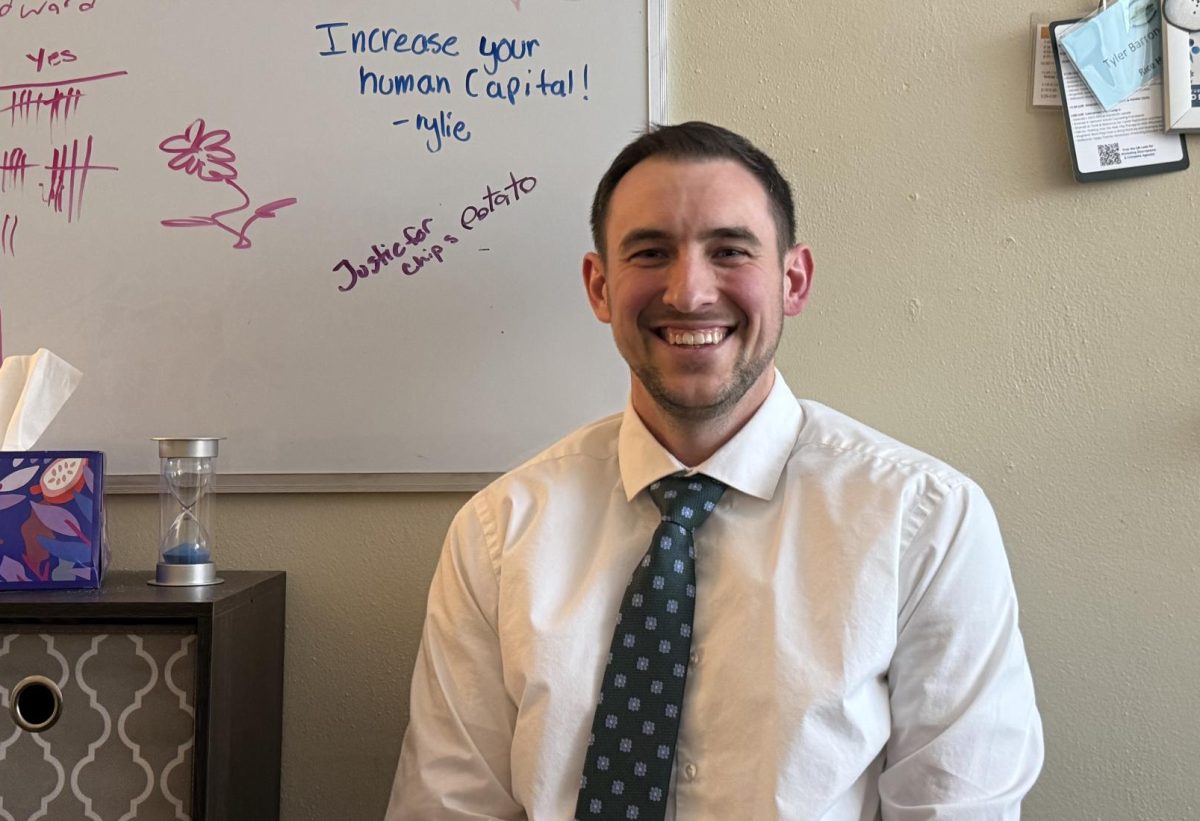
Tyler Barron first started at Rice as an intern in 2022 while he was completing his masters. In the fall 2023, he was welcomed on full-time and has since found his spots in one of Rice’s most beloved departments.
He is from Vermont and graduated from Burlington High School before continuing his education at Clarkson University, majoring in psychology and social sciences, and receiving a Master’s degree in counseling from Vermont State University.
What is your role at Rice?
I am a school counselor, so I support students with their academic goals and the social and emotional well-being of students at Rice. I help them plan for what life looks like after Rice, too, whether that be applying to college or going into the workforce or something in between. Those are kinda the three pillars of my job.
What does being a guidance counselor entail?
“Guidance counselor” is an old term, so now you don’t ever become a guidance counselor. School counselor is now like the actual term that is used in schools, and it’s intentionally shifted that way because the work that counselors have done in schools has shifted a lot over time, and it used to be much more around college and work stuff, and that was kind of exclusively it. And now there’s a lot more of a focus on mental health and well-being in the school, and a lot more preventative work that’s done by counselors, so the job has shifted in the last couple of decades.
What was the process of becoming a school counselor?
I had to get a graduate degree, so I got my Master’s degree in counseling from Northern Vermont University, which is now known as Vermont State University at the Johnson campus, and I went back to school part-time for a few years. I actually worked at the Howard Center in Burlington for 10 years. There are a couple of different branches of Howard Center, but I work primarily for Developmental Services, which is working with children and adults with developmental disabilities. So it might be on the autism spectrum, or have Down syndrome, or have an intellectual disability…people who just need extra support to move through life. And a lot of times I started working with them as they were transitioning from school, and kind of helped facilitate and manage what their life looked like once they lost school supports, because once your school day is no longer a part of your life, what is that filled in with if you don’t go to college, or if you don’t go into the workforce, and you need a lot of support with this your daily stuff?
Why did you choose this career path?
So while I was working at the Howard Center, I also coached basketball at Burlington High School for nine years. I was an assistant on the varsity team. So during the day, I was supporting individuals who needed a lot of help with things, and then in the evening, I was working with teenagers on the basketball court. And that kind of led me into this idea of maybe school counseling would be a cool profession for me, because it kind of blended my two worlds of being able to support people, but working with teenagers, so I went back to school part-time, and got my Master’s so I could become a school counselor.
What is it like working in the Rice guidance department?
Well, I mean, the Rice counselors are incredible people. Me, being the newest member of the team, I feel very fortunate to have the opportunity to work with them. They all have a lot of experience, but they were also very welcoming to me as I joined the team, and I feel like the culture in our department is really supportive; we really value each other’s perspective and we really work well together. I think that the community here at Rice is definitely unique and different from what I experienced in high school… I was very anti-Rice when I was younger. They [BHS and Rice] are rivals, and I wanted nothing to do with Rice, and as an adult, having the opportunity to be employed here, it’s definitely changed my perspective on what Rice has to offer people, and I really feel like it’s a unique place for students, and that we can really provide some individualized support that some other places just don’t have the capacity.
What is your favorite part about being a school counselor?
Yeah, it’s gonna be cliche, but working with the students. I think day-to-day, it’s how diverse my work is. I get to do a lot of different things, and I get to meet with students one-on-one. I get to meet with students in groups. I get to be in classrooms. I get to talk to parents. Sometimes I’m in really difficult meetings. Sometimes I’m in really light-hearted meetings. So, I like how much I get to do. It’s different all the time. You never really know what’s going to happen. And I do really value the small moments of interacting with students that are like sit-down formal, one-on-one meetings. It’s the” let me walk with you for 30 seconds in the hallway”, or somebody who pops in after school and talks for four minutes. Those interactions, for me, feel very valuable, and I feel like the relationship building that I get to have the opportunity to do here helps make me better at the actual counseling aspect of my job.
What is the hardest part of your job?
I think the hardest part is that there are situations where you can try to be as helpful as you can to certain people, and sometimes it’s not enough. And there are situations where maybe a student just isn’t ready, or there are other circumstances in their lives that are kind of getting in the way of them being successful, either in a class, as a student in general, or just in our community. And you know, when you go into a counseling profession, I think there’s a part of you that wants to help people, and you have this kind of internal feeling that if you just figure out the right way, you can fix a lot of things. And there are things that you know, even with it, with our time and resources here, that we’re not able to fix. Sometimes that’s a hard part of my job…I want everyone to be successful here, and if there is something I can do to help, I will do that.
What surprised you? What didn’t you expect about being a school counselor?
I don’t know if there was anything that really surprised me. I feel I got into this role at a time in my life where I was very thoughtful around what I wanted to do and what I was looking for in a job. So I think I had an understanding of what my job was going to look like. So I don’t think there was anything huge that caught me off guard. I think that there is something that is a big part of my job now that I’ve had to really learn through experience, and it’s kind of the only way to learn. It is the college application process–that’s a really stressful and complicated process for you all who are going through it and have gone through. The counselors are the primary people to help with that, and it’s really complex, and there are so many schools, and there are so many different pieces to it, and there are all of these little nuances. [For example,], if you’re going to apply to California schools, you need to remember this. And if you’re going to apply early decision, this is a really helpful little tip. Those things you don’t learn in a graduate school class–those are things you just have to learn from your colleagues, and then from going through the process over and over and over. So I think that was something I guess I didn’t necessarily expect.
What is it like working with your mom (Mrs. Barron) in school?
It happens almost every couple of weeks somebody will put that together and be like, “that’s your mom!” She’s been working here for way longer than I have. My sister actually went here, so I do have a connection to Rice, even if I didn’t go here. I think that she is a really valuable adult in the building who a lot of people rely on every day, both teachers, staff members and kids. She is somebody who interacts with everyone, and people tell me often how lucky we are to have her. So it makes me feel good that people see how valuable she is. There are days when I talk to her a couple of times, there are days when I don’t even see her, and when we are not at work, we never really talk about work. It’s kind of funny. We it’s, you know, she does like to see pictures of my child here and there, so I’ll go up and share stuff that has happened at home, but, but yeah, we have a great relationship, and always have, so it makes it easy. I appreciate that I have the opportunity to see her every day. That’s kind of a nice perk.
Do you have any advice for students?
I think that there’s a lot that happens in high school that feels really, really big just because of where you’re at in life, and it’s okay that things feel really big. And at the same time, high school is a set amount of time, and you will transition away from Rice. As you get older, you will look back and realize that there are things that felt really big now that you’re gonna giggle at or laugh at. So enjoy as much as you can here and when something feels really, really big, try to just try to reflect on it and kind of check yourself a little bit. And really be aware of how much energy you spend on things that are helping you.