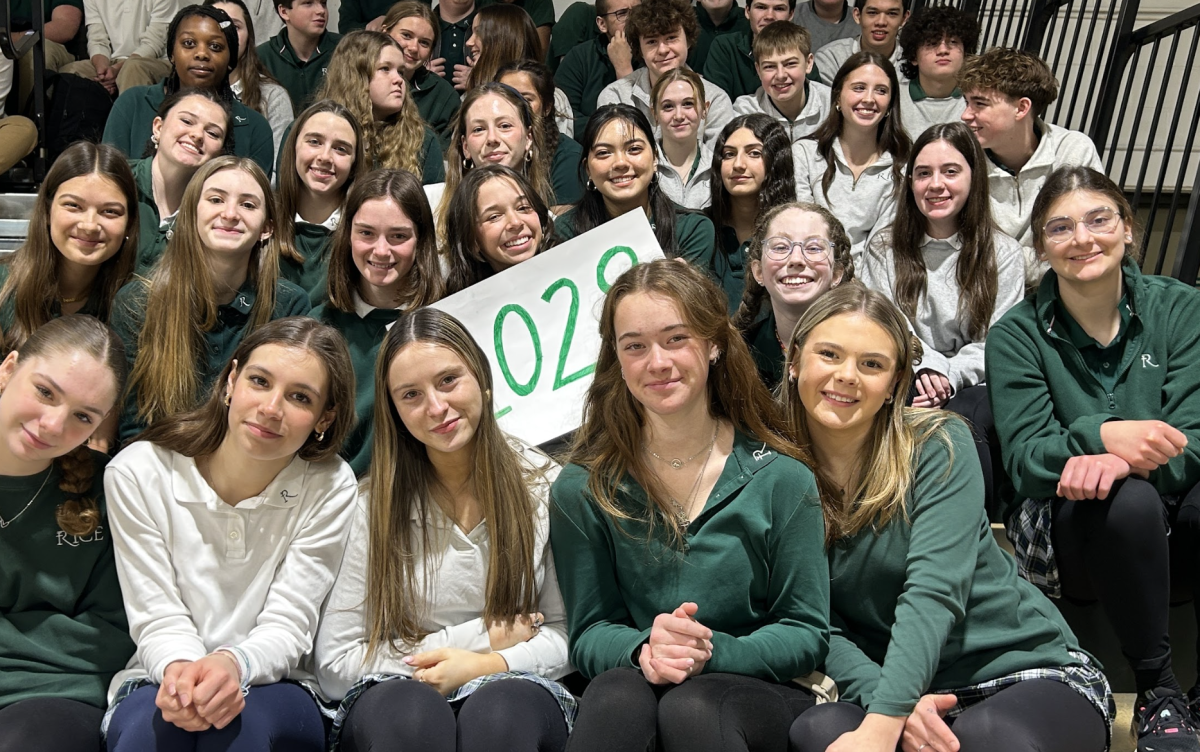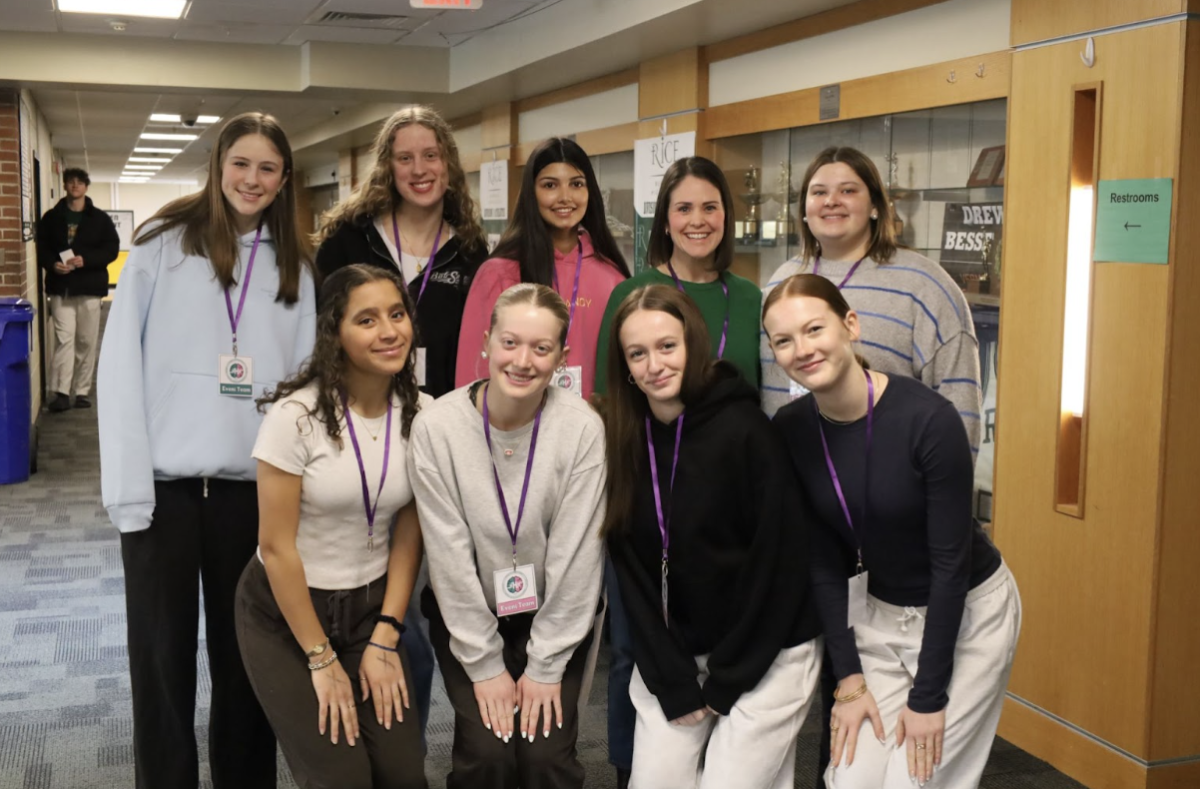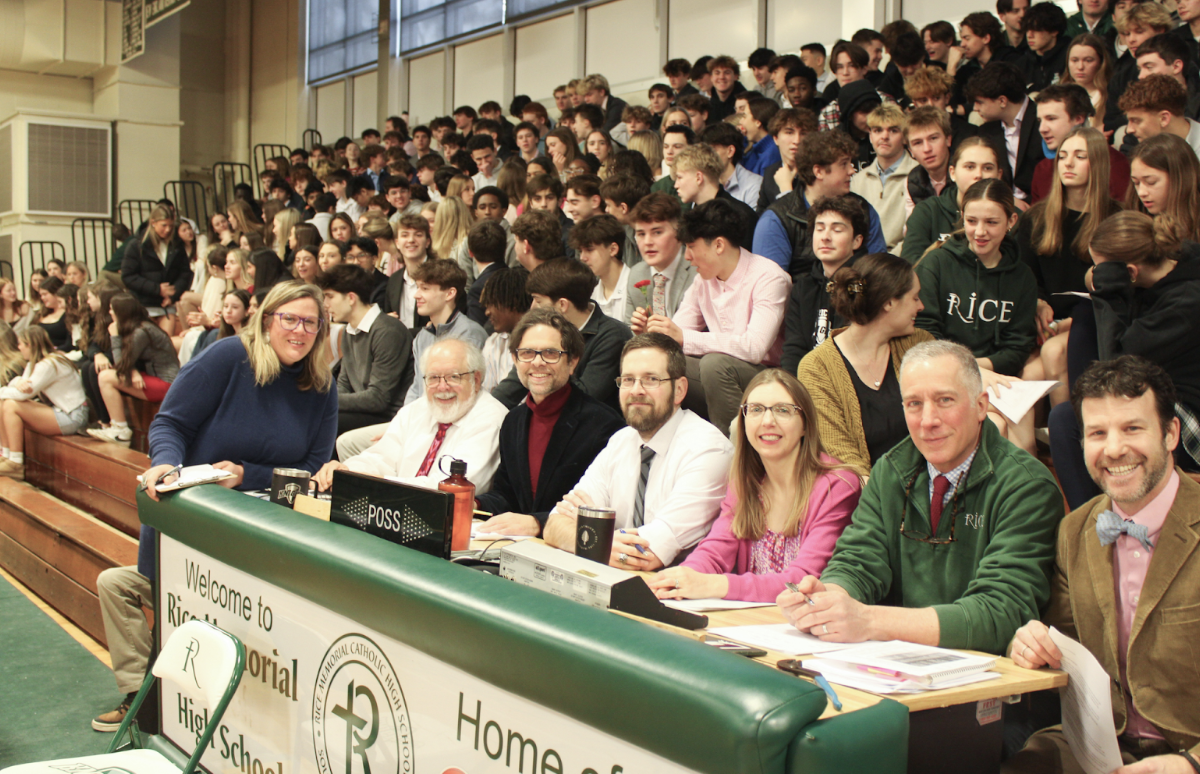
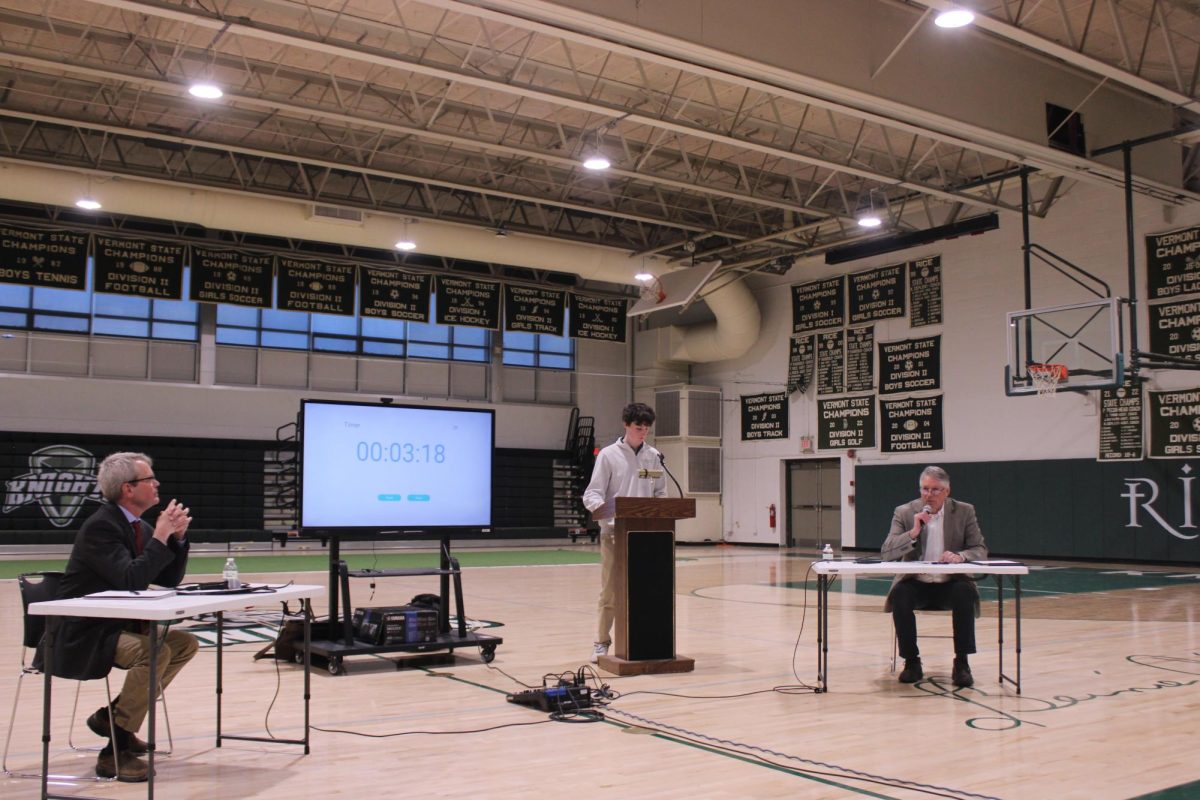
On Friday, March 27, Rice students gathered in the Bill Hammond Gymnasium to listen to a civil discourse about climate change. Students heard opposing arguments about what climate change would mean for future generations, while still watching the discussers behave civilly, something many see as lacking in our current political system.
The civil discourse consisted of two discussers, Rob Roper, a freelance writer and former president of the Ethan Allen Institute, and Paul Burns, the Executive Director of Vermont Public Interest Research Group. Each person was allotted time for three main arguments and for rebuttals to those arguments. Both agreed on a set definition of climate change as the belief that the climate is changing and the earth is getting warmer.
Before the civil discourse, freshman Mattea McCormick discussed what she was expecting out of the debate.
“I’m hoping that I will be able to see two sides of the story and hopefully learn a little more about climate change and its impact on the world.”
Roper argued that climate change is controllable and may even benefit the earth, as the climate has changed for millions of years without problem. He at one point said that Vermont may be able to grow peaches due to the changing climate, bringing new variety to Vermont’s agriculture. Furthermore, he expressed disbelief in renewable energies and technologies, such as wind power and electric cars, due to their high prices and expenses.
Burns, on the other hand, argued that climate change will be catastrophic for the next generation if nothing is done now. He referenced the floods in Vermont for three consecutive years, in the summers of 2023, 2024, and 2025, as these caused great harm and damage to Vermont and even caused the death of two people.
The civil discourse was facilitated by junior Will Cunningham, who said he did it because “Civility in discourse is rare nowadays, yet it is essential for functioning citizens in a democratic society. As such, schools should not ignore controversy, but rather embrace it, and demonstrate how debate can be used as a means of handling controversial topics… My hope was for students to not only gain insight into climate change solutions and their flaws, but also into the process of civil discourse itself.”
In our current political time, students are surrounded by animosity between differing views, especially on a divisive topic such as climate change. As senior Sergio Sotomonte-Hammond said prior to the civil discourse,”I’m mostly in it for the entertainment”, reflecting how polarizing debates are considered to be.
However, the point of the event was to show students that people can disagree on large issues without becoming angry. At some points, tensions were high on the disagreements between Roper and Burns, yet they never spilled into yelling or blaming each other. At all times they were respectful, listened to each other’s arguments, and waited until it was their turn to speak.
Burns and Roper both agreed that it was essential to have civil discourse for this reason.
Burns said he agreed to come because he wants people to know that disagreements don’t mean those you disagree with are villains.
“I wish we could disagree on basic issues without villainizing our, you know, the folks who disagree with us,” said Burns. “That is harder and harder to do now… That was one of the reasons why I came is to try to demonstrate that one could have civil disagreements over even really, really important topics where I really couldn’t disagree with Rob more on some of the things that we’re talking about, or some of the things that he’s saying.
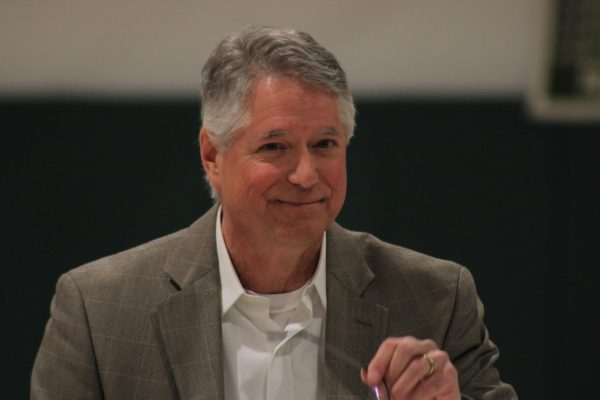
“I mean, I think I can say some of it, I think is highly irresponsible,” said Burns. “You know what he was saying to suggest climate change is not a catastrophe, because we can grow peaches here, I think is misleading. I think I can say those things as just that’s a statement of what I think is fact, but I don’t call them names or something like this. You know, we shake hands at the end. And I think that really is hopefully important to be able to demonstrate.”
Similarly, Roper said that he believed we need to be able to debate without being so emotionally driven, and that we need to understand other people’s perspectives.
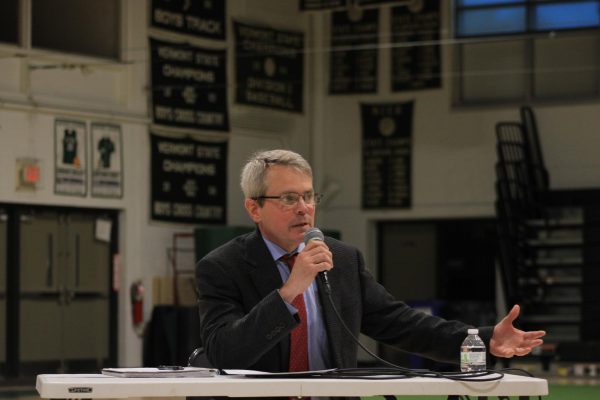
“These are complicated issues,” said Roper. “They’re very important issues. And we need to be able to have long, longer conversations that delve into the details so that everybody can understand them and understand, even if you disagree, what the other person’s perspective is.”
The maintenance of civility and respect showed students that people can disagree but still get along. When asked afterwards about the discourse, McCormick said that she saw a “way for people to have opposing opinions and still talk civilly about it, and also [learned more about] climate change and how it is being addressed in Vermont.”
Websites for both VPIRG and The Ethan Allen Institute can be found here.